Tuesday, June 3, 2014

What Steve Vai Taught Me About Performing

A number of years ago, while I was in college (mid 90s), I got to witness Steve Vai perform on multiple occasions. The first was on the Sex and Religion tour when his band played at Graffiti's club in Pittsburgh, with Devin Townsend on vocals. The show was simply amazing, and contained everything... heavy hard rock vocal numbers, melodic instrumentals, great audience participation, percussion/drum solo, jazzy numbers, mind boggling extended solos, and an amazing, and inspired energy.

A couple years later, I saw Steve play on the first G3 tour, and this was a much more concise performance, limited to 45 minutes, and his best material, but still inspired. A year or so after that, he toured behind the Fire Garden album, again playing at Graffiti in Pittsburgh. This show, again was jaw dropping, and felt so special, as if we were witnessing magic, on a particularly inspired evening. The crowd interaction, Steve's between-song banter, and the performance was just ...special.

I decided to drive down to Washington DC to catch the next show that weekend. This show was at the  now defunct Bayou in Georgetown. I brought a guitar student and my older brother with me... they had to witness what I saw in Pittsburgh. Much to my surprise, this show was nearly identical to the show in Pittsburgh, just two nights before. The same set of songs, the same between-song banter, the same crowd participation scenario, almost every thing about it was the same. As soon as it occurred to me that Steve and the band were playing the same thing every night (hey, I was young and I assumed they changed it up), I was a little disappointed. That show in Pittsburgh wasn't special, it was like all the other shows...


This disappointment quickly faded, as I witnessed a seemingly just-as-inspired performance in Washington DC. Steve and the band were still giving 100%. Sure, it was a similar performance to the other night, but that didn't stop them from delivering. There were two differences from this show and the previous one and I relished them. First, Steve's amp crapped out in the middle of the song "Brothers", right before his solo would have started. His band played on, with Mike Keneally taking a keyboard solo while the crew scrambled to replace the amp - which they did just in time for Steve to deliver THE solo!  Secondly, towards the end Steve decided to smash his guitar to bits, and throw it into the audience, and then proceed to crowd surf in a very packed Bayou club. OK, now that was cool. (If Steve reads this, maybe he can interject a little about what he was feeling that night that prompted this.)

My take away from this was an important music lesson for me. When you are performing the same set of songs over and over, or if you are performing a song that you may feel is easy or boring, you can't let it be easy or boring. Your mind should be on multiple things:

1. Song Arc: Be mindful of the overall dynamic arc of the song, from intro, to verse, pre chorus, chorus, etc... How are you going to shape the song?
2. Part Arc: Each part of the song (Intro, Verse, Chorus, Bridge) has it's own dynamics, timing, and feel. How are you shaping each part of the song? Is it similar or in contrast to the other parts?
3. Line Arc: Each part of a song is made up of musical lines. Are you paying attention to the phrasing of these melodies and/or chord progressions? There may be a question and answer quality to these lines, are you performing them effectively? How are you shaping these lines?
4. Note Arc: Each melodic line or chord is made up of individual notes. How are you shaping these notes? Are they staccato, legato, loud, quiet? Does the timing occur ahead of the beat, or behind it? What is the envelope of each note and chord?

With all of this to think about, you can guarantee that the performance won't be "phoned in". You should be on your toes through every part of the performance. While much about performing is having the material down so well that it becomes second nature, you should always be mindful of how you shape each part of the song (on the macro and micro level). This will guarantee that you are "in tune" with the song, and can go a long way to delivering inspired performances no matter how many times you've played the set of songs.


Subscribe to Adrian's E-Newsletter and get a FREE MP3!


Monday, April 21, 2014

11 Pieces of Advice I Wish I Heard When I was a Music Student

Last week I recently received an email from a guitar student in his freshman year at my alma mater, Duquesne University, in Pittsburgh, PA. He was asking for some advice, stating,"Adrian, … I am a freshman guitar performance major at  Duquesne.  You are an inspiration to me because you are doing exactly what I hope to do one day and I was hoping you could tell me a little about how you got there. Thanks man.”


It’s funny, because I think people’s perception of “success” changes over time, and quite frankly, for some, it never feels like it has been obtained, no matter how much they have accomplished in their chosen field.

So considering this, my response was, “Hello, thank you for your message, I'm flattered. My story is a long one, but I think if you are looking for some career advice, I have some. I'll base it on what has worked for me, mistakes I've seen others make, and even stuff I wish I had done.”

You can see my advice below. After I read it, I wished someone told me some of this stuff when I was his age.


In no particular order:

1. You are at Duquesne, a great music school. I had a lot of fun there and excelled. I can't think of a music class there that wasn't important to my development as a musician... but while music is not a competition, the music business is. Look around to see how much people are practicing, and practice more. 

2. I'll assume you are in choir, which is great. I wish I continued to pursue singing more. If you aren't now, make sure you are working on your vocals. I love instrumental music, playing it and composing it, but the amount of gigs I could have gotten had my vocals been more together could have made a big difference. I am now singing more, and it's paying off. Every band audition I have gone to asks about singing.

3. My general advice to musicians is: Perform as often as possible, with as many people as possible, for as many people as possible. This is important. You will be making contacts that will turn into opportunities much faster the more gigs you play. A band leader, audience member, manager, agent, club owner, fellow musician, etc... will eventually refer you to another, bigger, better gig. The experience of performing, and entertaining is important and something you can really only learn on the job. In addition, you will be expanding your repertoire and musical vocabulary along the way.

4. When you look for a job, try to only do music related jobs... like teaching. I regret taking some office jobs for a few years, it kept me from getting where i am today that much sooner. Your 20s are a perfect time for living on hotdogs and paper plates, so pay your dues then, not in your mid 30s and 40s.

5. Take a performing job at the local theme park, or during the summer on a cruise ship. I didn't, but the guys who did ended up with serious reading chops that will come in handy for session work. Don't be embarrassed about playing goofy "Mickey Mouse" type music there, because your friends will be flipping burgers or working at the GAP... but, you'll be honing your chops, expanding your vocabulary, and meeting other musicians, playing 3-7 sets a day.

6. Buy these books and read them thoroughly: "Guerrilla Music Marketing Handbook" by Bob Baker (this book will give you the fundamentals of marketing, and sales, and help you get some success under your belt). "Everything You Need To Know About The Music Business" by Donald Passman (this book will aid you when the industry  start to recognize your success, and keep you from getting screwed). "The Music Lesson" by Victor Wooten (everything you kinda knew about music, but couldn't put into the right words).

7. Learn Jazz, Blues, Classical, Rock, Metal, Country, and finger style acoustic playing. Have a firm grasp of these and you can teach more students, perform more gigs, and record more sessions.

8. As soon as you have enough money saved, move to LA, NYC, or Nashville. In this day and age of internet, a lot is possible, but if you want the referrals and opportunities for the BIG gigs, they happen there. I don't know of anyone from my home town of Fairfax, VA who has gotten that huge tour/gig ... that didn't move to a music mecca first.

9. You can only rely on yourself. This business is rough, it isn't easy. Be focused, keep your eye on the ball. Those with a weaker stomach will quit, thinning "the herd", but you'll be gigging, networking, and getting your reputable name out there. Get a website and start putting together a press kit about yourself. You might not have much to put in there now, but its a start. When networking, it's not about what others can do for you, its really about what you can do for them. However, one day you may want to cash in on all those favors.

10. Be on time, know the material, perform, and know that there is huge value in that. Anyone can play great guitar (just check youtube!), but apparently not everyone can show up to a gig on time and know the material. Be polite, professional, and keep negative opinions of other artists to yourself. 

11. As a professional musician you will have to wear many hats to make ends meet: Teacher, Band Leader, Sideman, Session Guitarist, Songwriter, Producer, Engineer, Composer, Author, Clinician, Solo Artist... get started now.


Subscribe to Adrian's E-Newsletter and get a FREE MP3!


Tuesday, February 11, 2014

What Everyone is Saying about 'Tone Poet' (Press and Reviews)


Below you will find all reviews and press for my newest album, "Tone Poet". Keep checking this blog entry as more press and reviews will be added as they come.


"Tone Poet is definitely one of those albums where the sum is greater than the parts and the way the album flows across styles so effortlessly is one of its main strengths. The recording too is excellent – the punchiness of the drums really adds a lot to the dramatic impact here that Galysh has strived for." - ProgMetalZone.com


"Technical proficiency is alive and well on this offering of half pop-metal songs, and half melodic prog instrumental workouts". - Modern Drummer 


""Tone Poet" presents an entertaining balance of melody and menace - power and passion." - Prognaut.com

    Read the whole review by clicking here:  http://www.prognaut.com/reviews/adrian-galysh3.html


Artist Empowerment Radio Podcast Interview

*An interview with Bob Baker for his podcast, "Artist Empowerment Radio". Bob is the author of the excellent book, "Guerrilla Music Marketing for Musicians", which I highly recommend! 

    *Have a listen to Part 1 here: http://bob-baker.com/buzz/music-endorsements-sponsorships/

    *Have a listen to Part 2 here: http://bob-baker.com/buzz/guitar-instruction-videos/

Seymour Duncan Interview

Adrian talks Tone with Seymour Duncan pickups' Jay Hale in this interview. Read the complete interview here: http://www.seymourduncan.com/blog/backstage-pass/adrian-galysh-the-tone-poet/

"Guitar fans will love this album as will prog metal fans as Adrian’s playing and songs complement Mark Boals vocals so well." - GetReadyToRock.me.uk


"Every once and a while a musician comes along and releases an album that truly deserves attention and accolades.  In 2013, that musician is guitarist Adrian Galysh and the album is Tone Poet... Tone Poet rocks, is creatively excellent and sonically superb. Buy this one and play it loud and often." - ClassicRockRevisited.com

     Read the whole review by clicking here: 
http://www.classicrockrevisited.com/show_review.php?id=1205


Guitar Player Feb. 2014

"You don’t even have to be a “guitar guy” to get into this one, you just have to have an appreciation for rock music that’s on the creative side." - HardRockHaven.net

     Read the whole review by clicking here:  
http://hardrockhaven.net/online/2014/01/adrian-galysh-tone-poet-cd-review/

"In the daily muddle of music submissions, every once and a while, there comes an album that's bright and refreshing, even unexpected. Such is the case with guitarist and composer Adrian Galysh's fourth album, Tone Poet." - DangerDog.com

     Read the whole review by clicking here:  
http://www.dangerdog.com/2013-music-reviews/adrian-galysh-tone-poet.php

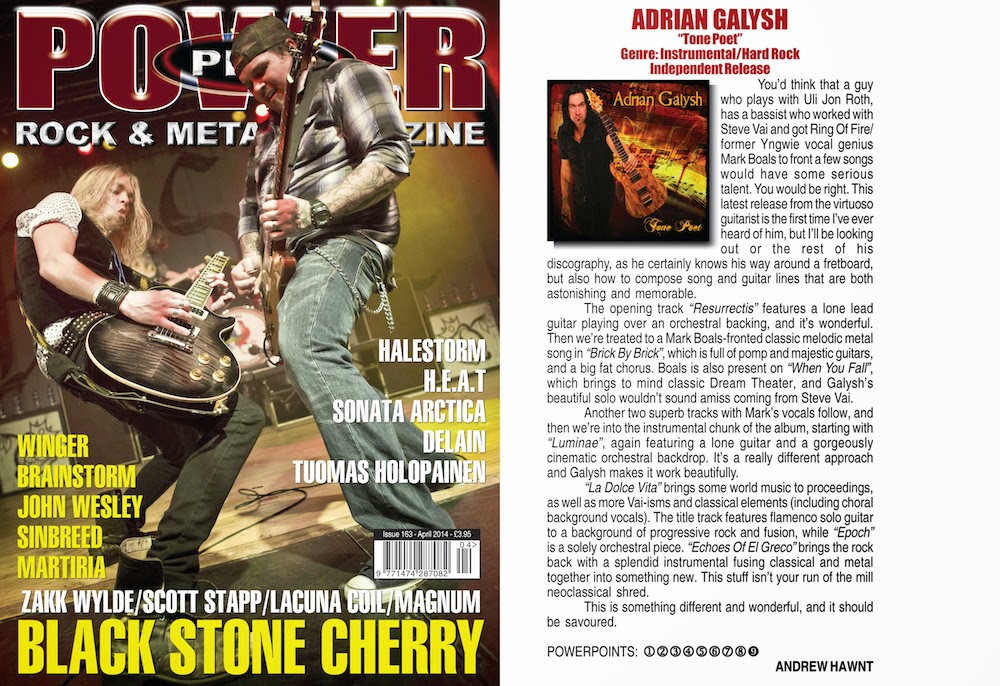
9/10! "This is something different and wonderful, and it should be savored". - Power Play Magazine (April 2014)

"It's remarkably understated for a solo album by a virtuoso guitar player and is full of really nice melodic moments and can be rewarding to repeated listens. If you have wide musical horizons and enjoy tasteful musicianship then 'Tone Poet' is definitely worth a listen." - MetalTalk.net

     
Read the whole review by clicking here: http://www.metaltalk.net/columns/20106627.php

"If you seek music that is different, moving, and mind expanding; your search is over, 'Tone Poet' is sure to satisfy and it's a keeper. The musicianship on this recording is truly world class." - Tony Cruz Sison

      Read the whole review by clicking here: 
http://thededicatedrockersociety.blogspot.com/2014/01/cd-reviews-for-january-2014.html

Interview with Dedicated Rocker Society 

"Hailed by critics and fellow musician alike, Los Angeles guitarist Adrian Galysh, showcases his guitar talents with anthem-like instrumentals, that put the focus squarely on catchy, memorable melodies. "I suppose its because I grew up listening to the hard rock bands of the 70s and 80s, like Van Halen, Scorpions, and Deep Purple," Galysh testifies, "I always enjoyed big riffs, catchy choruses, and interesting musical hooks". - The Dedicated Rocker Society


Interview with Classic Rock Revisited

"Classic Rock Revisited caught up with rock guitarist Adrian Galysh’s new album titled Tone Poet, which features vocalist Mark Boals and Styx drummer Todd Sucherman.  The album is a rich, well crafted, brilliantly composed work of art. In the interview below, Adrian takes time to share how the album came to be, his creative process, how he approaches guitar solos and his future plans.Enjoy this interview with a guy that may be under the radar, for now, but with Tone Poet, will be growing in both reputation and popularity."

     Read the whole interview by clicking here: http://www.classicrockrevisited.com/show_interview.php?id=1011

"Although Adrian was soloist, but this album Tone Poet, contained half vocalized track. This unfortunately makes him 'half-banned' from the guitar shred instrumental album. But his half of instrumental tracks really paid off the situation and make it great for guitar fans. Check him out as well as this awesome album." - MetalHarem.blogspot.com

      
Read the whole review by clicking here: http://metalharem.blogspot.com/2014/01/favorite-guitar-shred-instrumental.html

"Melodic, yet powerful is how I would sum up the music of  Tone Poet from Adrian Galysh. The fluidity of his work on the fret-board is hypnotic and magical. If you love music made for the love of music Tone Poet by Adrian Galysh is a necessity in you music collection." - TheHellionRocks.com

      Read the whole review by clicking here:  http://thehellionrocks.com/2013/12/04/adrian-galysh-tone-poet/


"Galysh has crafted an album with an abundant musical landscape with plenty of multi layered musical pieces featuring choral vocals, orchestral pieces and keyboards alongside his guitar which obviously takes the focal point of all the tracks." - Woody's Melodic Rock and AOR Reviews
     Read the whole review by clicking here:  http://www.woodysrockreviews.co.uk/album-reviews/adriangalysh-tonepoet

"The album begins with a church-like choir, bringing Galysh's two-minute solo on to a higher purpose in "Resurrectis." The band moves like a tight unit through "Brick By Brick" as Galysh combines orchestration with his hard rocking solo. The tempo slows down quickly for the power ballad "When You Fall," which showcases Boals' vocals perfectly." - JP's Music Blog


"A chorus, an orchestra, and Adrian Galysh's guitar opens Tone Poet. His lead lines weave over piano and something seems to be brewing, as if this is an opening overture to a larger experience." - SeaOfTranquility.org

     Read the whole review by clicking here:  http://www.seaoftranquility.org/reviews.php?op=showcontent&id=15725


Subscribe to Adrian's E-Newsletter and get a FREE MP3!


Thursday, December 12, 2013

6 Things You Never Knew About Bassist Philip Bynoe


Philip Bynoe and I have had a long musical friendship. I’ve known Philip for over 16 years. We met during the first G3 tour in ’96, we both moved to LA at the same time, and we have been playing together for over 13 years. Philip played on my 2002 release King Friday.


He’s my first call, go-to bassist with a great feel and groove that pushes the music forward. So it was a no-brainer to include him on my new album, Tone Poet. I must say, tracks that he plays on really benefited from his superb bass playing.


Philip Bynoe brings to the record both world-class bass playing and experience from years of touring and recording for artists such as Steve Vai, Kevin Eubanks, Slash, and Ring of Fire.


I recently caught up with Philip, who is on the road with Steve Vai. We discussed his musical influences, working with Steve again, the new album, and more.


You've played with some amazing artists from Steve Vai, Tony McAlpine, to Kevin Eubanks. But who are your musical influences? Do you have a favorite bass player or one that impressed you growing up?

As a bassist I have to say my father and older brother were my first big influences. When I was about 14 a friend introduced me to Stanley Clarke and that was a big day. I bought everything he released and learned it and from there to Weather Report and Jaco. Larry Graham was next as I was just listening to everybody.

You're back on the road with Steve Vai, how is touring with Steve different now than when you played together in the mid-late 90s?

Steve as a band leader and friend has developed his skills in the way he motivates the members of the band, which has us working together and growing musically in ways that none of us expected. The things we focus on are relaxing, being in the moment, phrasing and being musical. All things we did before, but now we work together to support each other, it's wonderful.

You tracked a handful of songs on my new album, Tone Poet, and you've been playing with me on and off for about 13 years... what have you noticed is different about my new material compared to say, "King Friday"?

As you have matured as a writer, the choices you make in creating music have grown also. Instead of forcing ideas into songs it sounds to me as if you're allowing the music to speak through you. As with all of us you have your signature sound and you have enhanced that.

Can you tell readers about the bass(es) and gear used to record your tracks on Tone Poet?

For this recording I used my Music Man Bongo 6 string basses, with the double humbucker pick ups. For my direct sound I went through a Digi 003 Black Box pre amp and used my SSL channel strip plug in. For live amp I used a 1200 watt tube amp with a 4/10 cab and a 421 mic on the cabinet.


Speaking of gear, what basses, effects, and amps are you touring with now?

My live rig and basses are, the a fore mentioned Music Man Bongo basses I have one with 2 humbuckers and the other is a single coil/humbucker set up. A 5 string Bongo fretless and a Kala ukulele bass that sounds like an upright.

What advise would you give aspiring bass players who may want to pursue a professional career in music?

As I tell the bass students at the LA Music Academy where I teach, it is a long road to be a musician. There are also many ways to be in the music business, if you start out with a plan of where you want to be and allow yourself to find your way, though it might take longer than you think, and your goals and dreams can change as you go along, if you allow that to happen you will find your way. Also don't get hung up in the game of "I wish I was doing that gig", enjoy what you are doing, do your best where you are and don't compare your life to others and you will have more fun and probably be more successful.


Subscribe to Adrian's E-Newsletter and get a FREE MP3!


Wednesday, December 11, 2013

Adrian Galysh Reveals Story Behind TONE POET, Track by Track


Tone Poet was two years in the making... maybe even longer, but real recording and writing started two years ago. I'd like to take you through each song, share my thoughts on each of them, and give you an idea of what inspired them, how they were written, and what challenges they may have presented. Below is a preview video, giving you samples of each of Tone Poet's 12 tracks.


1. "Resurrectis" - Track 6 ("Luminae") was so much fun to compose and record that I immediately started another classical/choral composition that turned into "Resurrectis". Shorter than "Luminae", I decided this would be the album opener. Something unexpected for some listeners, I'm sure. The last few measures are lush and beautiful and come to an epic crescendo, which sets us up for...


2. "Brick By Brick" - Another track written early on in the project. The riffs, and the arrangement of the demo were intended to be for a vocal song. Believe it or not, as I was writing and recording the rhythm parts for this song, I kept thinking... "what would Reb Beach do?". I like Reb's rhythm playing, and this is my version of some of his heavier style of playing from albums like Pull and IV. The lyrics were my idea, but Mark Boals wrote the majority of them. He'd send me lyrics, I'd send back some re-writes and revisions, then he'd do his final tracking at his home studio, and send me the vocal tracks to dump into my rhythm section tracks. Drums were recorded last, by Charlie Waymire at his studio, Ultimate Rhythm Studios.

3. "When You Fall" - Having a bit of writer's block a couple years ago, I tried to make things interesting by using an open tuning. The open tuning for "When You Fall" is inspired by Devin Townsend, who plays guitars tuned from low to high: C G C G C E. That is what my guitar is tuned to here. Boy, did this work. The song wrote itself in a day or two. Intro, verse, chorus... done. This started out as an instrumental, and somewhere I have "Morning Rain" with lead guitar over the whole track. However, this was a great opportunity to have a vocal ballad, and I asked Mark to include the idea of rain in the lyrics, as the rain and thunder effects were already a part of the arrangement. The unique guitar solo was 16 measures pulled from the original instrumental lead guitar take, and fit really well. The outro features six tracks of Mark's backing vocals, creating a lush background... Again, drums were recorded last by Charlie Waymire.


4. "Flying" - This was the first song written for the album. The main guitar riff, groove, and choral ending was all written as a demo about 4 years ago. At the time I knew this was going to be a vocal track. I refused to record a guitar melody over this, simply because I knew this would be a vocal song, and that vocalist would be Mark Boals. Mark and I worked out the lyrics over a few short days, trading emails, and some demo vocal takes. The most complicated part of the song is the middle guitar solo section. The rhythm of the riff behind the solo is odd, and didn't feel comfortable to play over, as the rhythmic figure comes back in unexpectedly. I ended up combining two solos, that now are heard as these intertwined parts, and it happened to work out well.

5. "Movie In My Mind" - This song was hard to make work. I had 2-3 good parts written, and they seemed to kinda work together, back to back. I wrote the lyrics myself - my first lyrics ever to make it to tape! After Mark tracked his parts, I took liberty to rearrange the song, putting in the piano intro, which is also found in the new middle section break. I rerecorded my rhythm guitar parts, and must have rerecorded the lead guitar parts 6 or 7 times. It wasn't until after the live drum parts were tracked (by Charlie Waymire), and that Philip Bynoe laid down his bass part that it started to really gel. I then tracked what would be the final lead guitar parts you now hear. I think "Movie In My Mind" is a unique song, with interesting production, and a catchy chorus.


6. "Luminae" - This was the first of the three classical pieces, and was exciting to write and record. Somewhat inspired by the classical work of Uli Jon Roth, this pulls inspiration from composers like Arvo Part and Vangelis. As lush and as complicated as it may sound, a great amount of it was done in just 2-3 days. Later on, before mixing, I returned to this piece to really fine tune all the strings, choir, and guitar. I have not heard of anyone else combining electric guitar with this kind of "epic" style choral composition, and I feel like it is really unique.

7. "La Dolce Vita" - Written around the same time as the classical pieces, this takes those elements of choir and strings and puts it to a beat. My thought process here was to alternate between acoustic guitar and electric guitar. The groove was to have a fusiony drum feel, that Todd Sucherman nailed. For me, the song really came together when I added the 2nd electric guitar part (right speaker) that answers the main electric guitar melody. Listen closely during the "choruses" for the very Italian sounding faux-mandolin guitar parts in the background. The most difficult performance of the recording was the middle acoustic guitar/piano double-time unison part. This alternate picked one-note-per-string arpeggio part with a moving melody was near impossible to play in time, and I even retracked this part (again) after the song was mixed! Todd Sucherman really hit this one out of the park - one of my favorite tracks on the album.

8. "Tone Poet" - An all acoustic effort. My attempt at emulating Ukrainian "Bondura", which is a large multi-string instrument kind of like an autoharp meets a dulcimer. Tons of acoustic guitar tracks, doubling each other - both steel string and nylon (I think 4-5 guitars, some in stereo, some recorded in mono). The challenge here was to be able to perform these multi-tracked guitars in time, as the slightest deviation would make such a mess. The background heard underneath the ascending 16th note guitar part is inspired by Arvo Part's Tintinnabuli composition technique, using simple triads, with a rhythmically simple melody played counter to the three individual notes of the triad, but giving no weight to any particular note... How rock and roll, I know?! Again, Todd Sucherman's drums are outstanding here, and really show off a side of his playing that you don't get to hear when he's on the road with Styx. This song's groove felt much stronger after Philip Bynoe tracked his bass parts.

9. "Epoch" - I debated whether or not to include this composition on Tone Poet. There's no guitar! But I felt that it showed another side to me, and is a breakthrough for me in recording quality orchestral music. I thought about trying to track some guitar, but then thought "nahh...". The biggest challenge of this track was getting the various string parts to sound in time, as they tend to drag a bit with a slow attack. I really like the lead melody violin part, which delivers a very emotional performance.

10. "Echoes of El Greco" - This track started out with the simple 16th note rhythm guitar parts against the double bass drums... just messing with programming double bass drums, really. The big electric guitar part is my take on the not nearly asked enough question, "what if John Sykes were to write an instrumental?"...I wanted it to be "Crying in the Rain" - huge, and then schizophrenically switch to a Latin inspired neo-flamenco guitar solo section. This is a high energy, fun track to listen to, and according to Todd, was very taxing to record!

11. "Ur of the Chaldees" - Another track that got its start from Devin Townsend's open guitar tuning, C G C G C E. The song was written starting with the strummed guitar part, then the acoustic guitar melody. Over the coarse of the rest of the composition, it morphs into a middle eastern, world music inspired musical caravan. Layers, and layers of guitar, strings, choir, violin, percussion, and more percussion. The outro trading electric guitar solos are all the same takes from the original demo, they may not be perfect, technically, but they feel good and have the right energy. Not an easy track to mix.

12. "Spring (The Return)" - There are three parts to this song. The intro/verse, the "prechorus" harmony guitars, and the chorus featuring the arpeggiated guitar melody. But as simple as the arrangement is, boy does that chorus melody pay off. This guitar part was me experimenting with a one-note-per-string arpeggio figure with this moving melody line above. The left hand stretch and the right hand picking was a real challenge. So much so that I probably re-tracked this part a couple times, just to make sure the triplet timing was just right. The outro solo is a single take. The benefit of playing guitar more and more on a regular basis is that I find myself liking the first and second takes, and not laboring to "fix" and "punch in" any trouble spots. Listen closely to hear the background soprano vocal harmonies underneath the 2nd chorus and outro solo.  

Subscribe to Adrian's E-Newsletter and get a FREE MP3!

Sunday, December 1, 2013

Help promote TONE POET by Adrian Galysh and get stuff!!

I have started this Rocket Hub campaign to help raise funds that will pay for advertising, promotion, PR, and some uber-cool looking Tone Poet T-Shirts. The year ahead will be filled with live performances, music conventions, and a media blitz that will include album reviews, interviews, and ads on both the internet and traditional print media. 

Please have a listen to the Tone Poet Preview video, to hear how fantastic the new album sounds, and to get an idea of the quality I will pursue in promoting this exciting project. I appreciate your support! Campaign ends on December 6th, so take advantage of these great deals now! Click here to support and get rewarded! http://rkthb.co/35387


Click here to support and get rewarded! http://rkthb.co/35387

Wednesday, November 20, 2013

Styx's Todd Sucherman: Exclusive Interview & Behind the Scenes Studio Footage


Most music fans may know of Todd Sucherman from seeing him play drums on tour with 70s & 80s rock giants, Styx, for the last 17 years. The perennial arena rock favorites perform a healthy schedule of over 150 shows a year. Drummers know of Todd Sucherman from the pages and covers of DRUM! and Modern Drummer Magazine, where he's won multiple reader's poll awards, including #1 Rock Drummer (2009 Modern Drummer).

I’ve known Todd for about 10 years. We were neighbors in Los Angeles before he moved to Austin, Texas. We’ve discussed working together for a long time, but due to his busy tour schedule and the distance (I still live in LA), we weren’t able to do it till now. Todd is a really tasteful drummer, very musical, with a ton of chops - totally in league with the likes of Colaiuta, Smith, and Bozzio. His performance on my new album, Tone Poet, is outstanding, and really shows off a side of his playing that people may not have heard yet. Every time I listen to the his tracks on Tone Poet I hear something new, clever, and musical - and I love that. (note: Tone Poet is available on itunes here)


Below is a recent interview I did with Todd, where I was able to get better insight into what made him the player his is today, as well as discuss his approach to tracking for Tone Poet.


Hi Todd, I assume you are on tour, how are you and where are you?

I am and I'm good.  A little crispy perhaps but good!  I'm on the Oregon coast at the moment but I've been to Europe twice and everywhere in the US from coast to coast in the last few weeks.

Lets start at the beginning. Your father was a jazz drummer, and got you into drumming, as well. What’s your earliest memory of playing the drums, or wanting to play drums?

I was in love with the drums since I was an infant. It's all I ever wanted to do from the beginning.  My father saw that I had an interest and a sense of rhythm early on so he worked with me and got me to the point where I played my first gig (with my older brothers) at age six. 

You got started early! Did you ever take lessons, as a kid?

Yes, starting with my father and because I had two older brothers in the junior high band  (on piano and bass guitar respectively) they paved the way for me to be in the junior high band from first grade on all the way through eighth grade.  Then I went through the high school band program all the while gigging on weekends and really didn't take any proper lessons until I went to Berklee in Boston for one year.

Beier Steel Snare  http://beierdrums.com


Before scoring the gig with STYX, what kind of work and gigging were you doing in Chicago?

When I got back from Berklee I did every gig possible. You name it.  I played tons of weddings and corporate parties, jazz clubs, rock clubs, basically anything and everything I could do. This lead to getting into the recording scene and doing records and a lot of jingles.  Chicago was a giant jingle town back then and that was a very exciting time. I was young and had kits being carted all over the city to different studios.  Those were great times.

That leads me to my next question. You got called to record for Styx when John Panozzo fell ill. Typically musicians get gigs by “knowing somebody”... who’d you know, and do you remember how it felt to get the call to become a “permanent” member of Styx?

Keith Marks, who handled the cartage of my gear from studio sessions recommended me to the guys. That's how it began basically.  Just a session. Then they called me for another session almost a year later. Then they asked me if I had summer plans, and that was for the '96 reunion tour.  I've never been made a "member", I've just sort of hung around for the last 17 years, so to speak!

Styx seems to tour non-stop. Do you still get inspired to practice when you are on a day off or at home? If so, what kind of stuff do you work on?

It helps to have new things and projects to practice for…as opposed to just being alone and thinking, "what shall I do today?" But it does feel good to sit at my little jazz kit and work on different things instead of playing high velocity rock stuff.  I try to let any inspiration hit me which is different than forcing things. If I get "stuck' I'll change some cymbals and grab a different snare drum, that will change the vibe right away.

Lets talk about your participation in my album, TONE POET. The first tracks I sent you were pretty rough. I’m pretty non-committal, and my demos will tend to be the framework of the song, with programmed drums, scratch guitars (except some solos), and a shit load of keyboard programming. What was your reaction when you first heard the tunes?

I'm used to hearing demos in all forms, from rough sketches to almost all final takes.  But I could hear a lot of cool things in what you sent and was keen to add some ideas to the process. I start thinking right away as I listen, then just listen, then think again.  There were some challenging bits musically and physically all the way to having to be ethereal and sensitive.  Music. Diversity.  It was a lot of fun to do!


You did a lot of listening to these demos while on the road. You had one day to record 5 tracks, and they turned out great. How did you prepare for this session? Do you chart things out?

It was exactly that.  Listen on the road, listen on airplanes, and then it's time to see if what I was hearing from the drums worked in the session, which was in fact done in one day.  I'm happy you liked them!

Were any musical parts or songs particularly challenging?

"Echoes of El Greco" was physically taxing.  I'm glad that went down quickly as that's the kind of track that will blow you out doing it over and over and over.

The track “Ur of the Chaldees” has a lot of layers and multiple tracks of percussion, drum set, and orchestral type playing, did you have a clear idea of how those parts were going to go down, or did you go for it and see what fits?

Part of it was predicated on some information from the original demo, and then I went from there. I have a few percussion bits I like to do that are subtle and effective.  I enjoy trying those ideas and seeing what works and what doesn't.  I love when the full kit kicks in for the end ride out. The whole piece is very majestic.  Like taking acid while riding an elephant through an exotic triumphant parade. How's that, huh? 

I'll have to use that quote in the press release, ha! Now that the album is mixed and mastered, is there a favorite track?

No, because there are moments I enjoy on each track.  I like it that way.  I like when I feel that way about a collection of songs.


Can you run through the drums, cymbals, and other gear you used for this session?

Oh man. I used a Pearl Masterworks kit for the drums with a few snare drums, probably 5 different ones.  I seem to remember using a Dunnett Magnesium, a Tempus drum made of hemp, the Sucherman/Stanbridge Empyrean, perhaps the Dunnett Titanium.  There were a whole bunch of Sabian cymbals chosen for each track so that would be impossible to remember. All the microphones were Audix going through Presonus ADL 600, Neve and Focusrite mic pres.

So besides further touring with STYX, what is on the horizon for you musically?

Good question as I'm not sure.  "You're catching me in a transitional phase" so to speak!  I have some ideas and notions but not sure where they will lead.  I'm still enjoying playing with the band for now, so I'm quite content.  I'd like to do my own record at some point but we'll see. There's a lot involved with that, as you know.

Thanks Todd!


For more information, visit www.AdrianGalysh.com

Subscribe to Adrian's E-Newsletter and get a FREE MP3!